
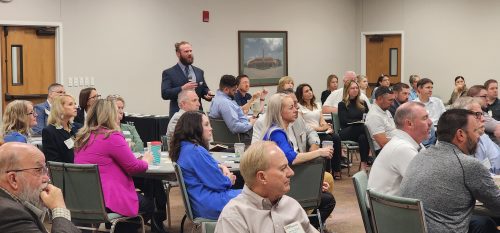
On May 20, 2025, the Center for Economic Development and Business Research (CEDBR) welcomed 55 regional business and community leaders to our Q2 Industry Research Exchange (IRE). The session focused on the evolving Economic Impact of Tariffs on the Wichita area and broader Kansas economy.
Setting the Stage: Trade Trends and Global Interdependencies
The event began with a data-driven overview from CEDBR staff, highlighting Kansas’ key trading partners, top import/export commodities, and the deep integration of global supply chains in the production of goods and services in the region.
Craig Compton, Research Economist at CEDBR, opened with a comprehensive look at Kansas’ trade flows. He noted that Kansas’ top imports (primarily machinery, transportation equipment, and electronic components) come from Canada ($2B), Germany ($1.8B), Japan ($1.6B), China ($1.5B), and Mexico ($1.4B). Notably, Canadian imports have now surpassed those from China, reflecting a broader realignment in trade priorities.

On the export side, Kansas maintains strong markets in Mexico ($3.1B), Canada ($2.6B), Japan ($1.1B), China ($823M), and the United Kingdom ($543M), with Mexico emerging as an increasingly dominant partner. Craig emphasized a long-term trend: growing reliance on North American partners and a gradual pullback from Chinese trade relationships.
Bekah Selby-Leach, Director of CEDBR, expanded on this by quantifying the economic footprint of international trade. In 2024, Kansas imported over $14 billion in physical goods and saw nearly $36 billion in total trade-related economic value, including goods, services, and employment.

Importantly, 61% of this value was tied directly to inputs for in-state production. She highlighted natural gas and crude petroleum as leading imported intermediate goods, with approximately 68% sourced internationally. Bekah’s remarks illustrated the complexity of global supply chains and the ripple effects tariffs can have across all levels of production.
Policy Perspective: The Broader Impact of Tariffs
Laura Lombard, Director of the International Division of the Kansas Department of Commerce was invited by CEDBR to discuss how these tariffs are playing – or are expected to play out – on the Kansas Economy. She noted that the impact included a contraction of GDP, declines in consumer confidence, volatility in the stock market, and potential implications on inflation and the value of the US dollar. Additionally, she explained that there are some potential upsides as some foreign companies are increasingly exploring options for foreign direct investment into the United States. She then highlighted the differing impacts by industry, noting that manufacturers have only been slightly impacted, retaliatory Chinese tariffs are aimed at harming agriculture (a base for the Republican party), and challenges faced by the logistics and distribution sector due to the uncertainty created by tariffs. She concluded with a discussion about how, in the end, Kansas families are the most affected through increased prices, potential shortages, decreased choices, and potential job loss.

Industry Panel: Voices from the Supply Chain
The session concluded with an engaging panel featuring leaders from three key industries:
- Brad Haas, President of Kansas-Oklahoma Machine Tools
- Andrew Lovick, Territory Manager at Central Plains Steel
- Amisha Daniels, Project Development Manager at McCownGordon Manufacturing
Each panelist brought a unique supply chain perspective to the discussion.

Andrew Lovick expressed optimism. His company is somewhat insulated from direct global impacts, with most global exposure coming through second-tier suppliers. Despite tariffs, business has remained strong. He’s hopeful that policy shifts may boost regional manufacturing, creating positive ripple effects in demand. He added that Central Plains Steel is well-positioned to absorb increased demand without major strain.
Brad Haas, whose company relies heavily on specialized imported machinery, painted a more cautious picture. While they haven’t yet experienced disruptions, he noted that long lead times make them vulnerable to future supply chain slowdowns. Preparation is underway for potential impacts.
Amisha Daniels, speaking from a commercial construction perspective, offered a pragmatic take. The industry, she said, has already adapted to extended lead times following the pandemic and past economic slowdown and noted it a “blessing in disguise” that allowed firms to navigate challenging supply chain disruptions. She expressed confidence in the industry’s ability to scale with increased demand.
Takeaways from the WAOT Meeting
Following the IRE event, CEDBR convened its Wichita Area Outlook Team (WAOT) for a pulse check on regional economic conditions. The conversation revealed a clear throughline: uncertainty is the defining theme across sectors, with tariffs, interest rates, labor, and infrastructure constraints shaping the regional outlook.
Tariffs: Indirect but Growing Influence
While most businesses aren’t yet directly constrained by tariffs, many are bracing for impact:
- Several industries reported pre-purchasing of equipment in anticipation of cost increases.
- Manufacturing and agriculture appear particularly vulnerable. High equipment costs, especially for items sourced from countries like Canada, and long lead times were flagged as growing concerns.
- There’s widespread speculation that larger effects will be felt later in the year, once more tariff measures are formalized.
- The agriculture sector remains cautious, citing weak profitability and skepticism that recent trade deals (like the UK beef agreement) will offset losses from reduced access to China.
- Some firms expressed concern about how tariffs might exacerbate already elevated property taxes and other cost pressures.
General Business Sentiment: Flat but Resilient
After a decade of expansion, many firms described 2025 as a transition year:
- A number of leaders reported flattening demand or a cooling off in new projects, though activity remains healthy in core areas like industrial development, data centers, and healthcare infrastructure.
- The construction and architecture sectors are watching closely for delays or cancellations, but most projects are moving forward for now.
- There’s growing interest in reshoring and regional development, but uncertainty about how far-reaching the benefits will be.
Investment and Financing: Holding Pattern
Financial institutions and service providers described a mixed environment:
- Loan demand is up, but clients are hesitant and caught between rising rates and unclear policy direction.
- Investors are slowly returning after retreating during peak rate hikes, with industrial and distribution facilities leading new investment trends.
- Accounting and consulting firms are staying busy, but acknowledge a potential slowdown if uncertainty drags on. Talent pipelines are improving, with more students entering accounting and firms not yet needing to offshore work.
Labor, Talent, and Infrastructure: Ongoing Pressures
Across nearly every sector, workforce and infrastructure needs are top-of-mind:
- Labor shortages remain a constraint, particularly in skilled trades and technical roles.
- There’s growing emphasis on childcare access and workforce retention as key factors in long-term economic development.
- Energy infrastructure is emerging as a potential bottleneck, with surging interest in data centers possibly requiring new pipelines to avoid capacity issues.
- Airport expansion efforts are underway, but attracting new destinations depends on demonstrating local business growth and travel demand.
Innovation and AI: Watch and Wait
While artificial intelligence is part of the conversation, most leaders see it as a future consideration, not a present driver of productivity or displacement. Some are experimenting with AI in marketing or process automation, but widespread adoption is not yet viable for most.
Overall
Together, the Industry Research Exchange and the Wichita Area Outlook Team discussions painted a nuanced picture of Kansas’ economic landscape in 2025 – one marked by resilience in the face of rising uncertainty. Tariffs, global trade shifts, and supply chain pressures are beginning to influence decisions across sectors, yet many local leaders remain cautiously optimistic, adapting strategies and watching for signals that will shape their next moves. As Kansas continues to attract investment, expand infrastructure, and navigate policy shifts, staying informed and collaborative will be critical. CEDBR remains committed to fostering these essential conversations, ensuring regional stakeholders are equipped to respond with clarity and confidence.
Not Your Experience?
Let us know what’s happening in your industry down in the comments.
Leave a Reply